
It’s easy to think you need a large backyard or a lot of acreage to create a meaningful outdoor living space. After all, when you start looking at decks, patios, outdoor kitchens, landscaping, and all the other possibilities, a small yard can seem limiting.
The reality is, less square footage doesn’t mean fewer opportunities. In many cases, a smaller space allows you to focus your investment on the areas that matter most to you instead of trying to fill every square foot with something.
The key is being intentional from the beginning. A smaller yard may not have enough room for every backyard feature you can think of. Trying to fit everything into the space can quickly have the opposite effect of a functional backyard.
Instead, start by thinking about what you actually want from your backyard. Do you want a place to eat dinner outside? Somewhere to grill and entertain? A quiet place to sit? Room for the kids or dogs? Once you know how you want to use the space, you can prioritize the features that will give you the most function and enjoyment.
Here are some small backyard design ideas and considerations to help you make the most of your space
Before deciding whether you need a deck, patio, pergola, garden beds, or anything else, start with how you want to spend time outside
Think about the activities that are most important to you. Maybe you want to dine outside with your family, host friends and grill on the weekends, sit outside with your morning coffee, or have a garden.
A small yard may not have enough space for every possible use, and that’s okay. We would rather see a homeowner create one or two areas that function really well than try to fit five different ideas into a yard that can’t comfortably accommodate them.
Decide what matters most and prioritize those spaces from the beginning.
Furniture should be part of this conversation, too. If you already have outdoor furniture you love, design the space around it so you know your deck or patio will actually accommodate it. If you’re starting from scratch, plan the furniture and outdoor space together. The size and placement of your furniture can have a significant impact on how much usable space you have.
The goal is to make sure the space you create flows the way you intend it to.
Larger backyards have the ability to easily separate different areas. You might have a deck near the house, a patio farther out in the yard, and plenty of lawn between the two.
A smaller backyard usually doesn’t have that kind of room.
Rather than trying to create several completely separate spaces, we recommend thinking about the backyard as one cohesive outdoor living area that can serve multiple purposes.
This is where an intentional design build process becomes especially important. Working with a design build team can help you determine which areas make the most sense in your current outdoor space and how to create a space that meets your needs while feeling cohesive with the surrounding area.
One way to create distinct zones is through changes in materials or elevation.
For example, you could have an elevated deck designed for dining that steps down to a concrete patio where the grill and a few raised garden beds are located. Each area has a different purpose, but they still work together as one outdoor space.
Ground-level patios can be especially useful in a smaller backyard because they allow you to create a functional zone while keeping the entire space on one level. This can help the backyard feel more cohesive rather than broken up into a collection of small areas.
Hardscaping and plantings can also help define where one use ends and another begins without requiring a physical wall between them.
The goal isn’t to create as many zones as possible. It’s to give the space enough definition that each area has a purpose while still allowing the backyard to function as a whole.
When you have limited outdoor space, don’t think only about the property beyond the back door. Look at the house, too. Sometimes one of the best ways to make a small backyard work harder is to create a stronger connection between the indoor and outdoor spaces.
Doorways and openings can help visually connect the interior and exterior, making the outdoor area feel like a natural extension of the home.
Depending on the home and the design, products such as Turnkey porch windows can also help blend the indoors with the outdoors while creating a more flexible area to enjoy.
You can’t create more property, but you can make better use of the square footage you already have.
Every backyard has limitations. Maybe the lot is narrow. Maybe the house sits close to the property line. Maybe the yard slopes dramatically. Or maybe you simply don’t have much room between your home and your neighbors.
Great yard design ideas don’t try to ignore those limitations. They work with them.
Some homes lend themselves to creating outdoor space on more than one level. For example, an upper and lower deck or a deck positioned above a patio can give you another outdoor area without expanding the property’s footprint. This can be particularly useful when the available ground space is limited. Instead of trying to spread everything farther across the yard, you’re using the vertical space that’s available to you.
Of course, not every home or property will be a candidate for this type of design. The home’s layout, grade, structure, and other site conditions all need to be considered before deciding on the right solution.
Privacy can feel more difficult to achieve in a small backyard.
On a larger property, you may naturally have some distance between your outdoor space and your neighbors. On a smaller lot, you may need to be more intentional about blocking neighboring sightlines.
A standard privacy fence can certainly get the job done, but it isn’t always our first choice from a design perspective.
Instead, consider natural plantings that create a living barrier, a partition wall with an artistic element, or an ivy or living wall. Adding plants around the perimeter can also soften the edges of the space and make privacy features feel intentional rather than something that was added simply to block a neighbor’s view.
The right approach will depend on your home, your property, and what you want the space to feel like.
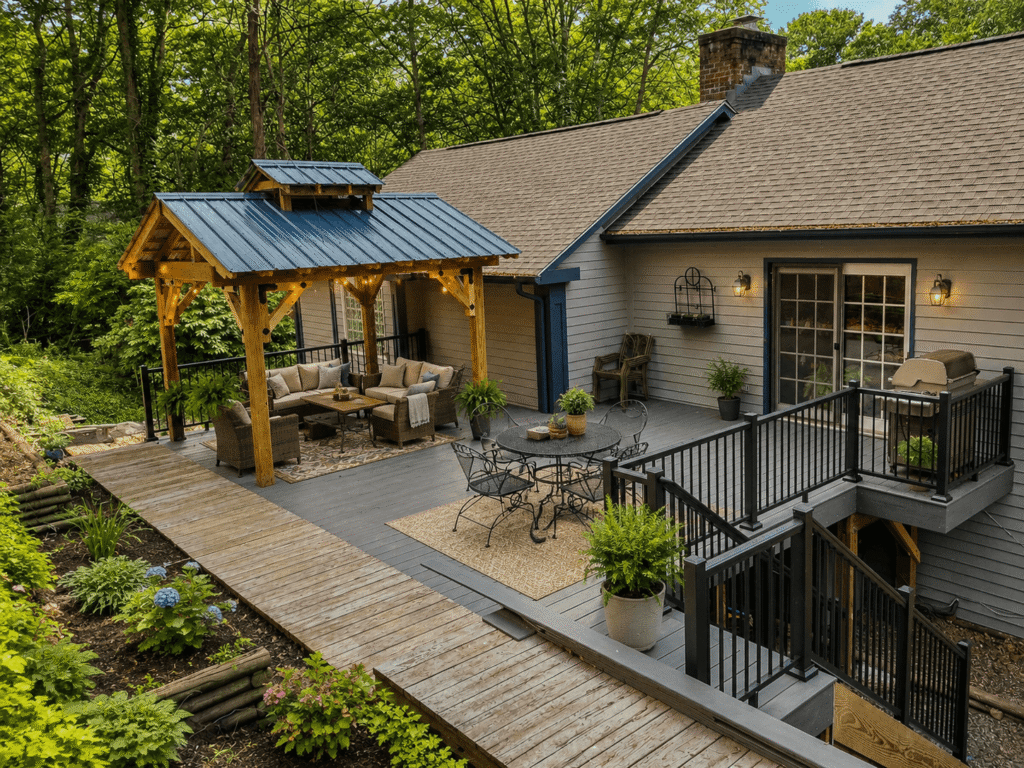
Sometimes the challenge is less about adding more and more about making smarter use of what’s already there.
We recently worked on a project where the back of the home butted directly into a hillside. The existing backyard wasn’t particularly usable, and the homeowners already had an old deck that needed to be replaced. They wanted to create more functional outdoor space without fighting against the hillside.
Our solution was to create a larger deck that met the rear entry and then blended into the steep hillside. A pergola was added at the same level as the deck, giving the homeowners a flexible area that could function as part of the larger deck or be closed off with curtains when they wanted more privacy or a more intimate dining experience.
We also created an extension beside the rear entry specifically for the grill. This gave the grill its own designated space without sacrificing valuable space in the primary entertaining area.
The stairs were relocated as well, which opened up more usable space in the rest of the backyard.
One additional benefit of the new design was that it helped tuck away some of the home’s HVAC mechanical units. The equipment was necessary, but in an already small backyard, it was taking up both visual and physical space.
The result was a backyard that worked much harder for the homeowners without requiring a larger property. That’s what thoughtful small yard design comes down to: understanding the conditions, identifying what matters most, and finding ways for each part of the design to serve a purpose.
You also don’t have to complete everything at once. If your budget doesn’t allow for a full outdoor living transformation right now, start with the improvements that will make you actually want to use the backyard.
If the yard is muddy, overgrown, or doesn’t give you anywhere comfortable to sit, chances are you aren’t going to spend much time out there, no matter how much potential it has. Start by improving the ground space. That might mean investing in a simple patio or improving the grass. Add natural plantings to bring some life into the space and create privacy where it’s needed. Most importantly, give yourself somewhere comfortable to sit.
Sometimes that’s enough to get you outside and enjoying the space. Additional improvements can come later as your needs and budget allow.
A small backyard doesn’t have to limit what you can do with your outdoor space.
The most successful small backyard designs start with how you actually want to use the space. From there, you can determine which features make sense, how different uses can work together, and where you can take advantage of the home’s layout, vertical space, landscaping, and hardscaping.
You may not have room for everything. You don’t need to.
With thoughtful planning, any backyard can become a comfortable, functional outdoor living space that feels like it was designed specifically for the way you live.
If you’re ready to make better use of your outdoor space, explore our outdoor living services to see how thoughtful design and construction can transform your backyard.

 Request a Consultation


